Bayesian baseline PAMMs: mgcv, jagam, and brms
2026-08-13
Source:vignettes/bayesian.Rmd
bayesian.RmdShow package setup
This vignette compares baseline cumulative hazard estimates from:
- a default frequentist PAMM fit with
mgcv, - a Bayesian PAMM fit via
mgcv::jagam(Wood 2016), which generates JAGS (Plummer 2003) code from the GAM specification and samples it withrjags, - a Bayesian PAMM fit via
brms(Bürkner 2017) (which compiles the model to Stan).
All models use the same spline basis for the baseline hazard, and we compare them against the Nelson-Aalen estimate and against each other on a common time grid.
Build note. The JAGS and Stan fits run on an ~11,600-row piece-wise exponential data set and take 15–20 minutes combined – too slow to evaluate on every build. The model-fitting and prediction code below is therefore shown but not executed (
eval = FALSE); it is run once byvignettes/precompute_bayesian.R, which saves the resultingpred_dftobayesian_results.rds. The plots and tables below are rendered live from that saved data frame. Runningrjagsadditionally needs a JAGS installation, andbrmsneeds a working Stan toolchain.
Model fits
2) Bayesian PAMM via jagam + rjags
set.seed(101)

jagam_file <- tempfile(fileext = ".jags")
pam_jagam_prep <- mgcv::jagam(
  formula = ped_status ~ s(tend, k = 20),
  data = ped,
  family = poisson(),
  offset = offset,
  file = jagam_file,
  sp.prior = "gamma",
  diagonalize = TRUE
)

library(rjags)
rjags::load.module("glm")
jagam_sampler <- rjags::jags.model(
  file = jagam_file,
  data = pam_jagam_prep$jags.data,
  inits = pam_jagam_prep$jags.ini, # data-driven starts from the penalised GAM
  n.chains = 2,
  quiet = FALSE
)

jagam_post <- rjags::jags.samples(
  model = jagam_sampler,
  variable.names = c("b", "lambda"),
  n.iter = 4000,
  thin = 10
)

pam_jagam <- mgcv::sim2jam(jagam_post, pam_jagam_prep$pregam)
3) Bayesian PAMM via brms
library(brms)
set.seed(101)

# The PED has many rows, so each Stan iteration is comparatively expensive;
# running the two chains on separate cores and starting from `init = 0`
# (a hazard of ~1 before the offset) gives a stable, reasonably quick fit.
pam_brms <- brms::brm(
  formula = ped_status ~ s(tend, k = 20) + offset(offset),
  data = ped,
  family = poisson(),
  chains = 2,
  cores = 2,
  iter = 3000,
  warmup = 750,
  init = 0,
  seed = 101,
  refresh = 0,
  silent = 1
)
summary(pam_brms)
brms::pp_check(pam_brms) +
  labs(title = "Posterior predictive check")
Common prediction pipeline
All three models are now driven through the same
add_cumu_hazard() call. For mgcv and
jagam this uses the analytic (coefficient-based) confidence
intervals as before. For brms we make the fit a first-class
pammtools backend by defining the two primitives of the unified
inference interface – get_hazard() (point hazard) and
sim_hazard() (matrix of posterior hazard draws). Once those
exist, add_cumu_hazard(ci_type = "sim") builds the
cumulative hazard and its posterior credible interval from them, so no
manual cumsum/quantile bookkeeping is needed. This is
exactly the mechanism the xgboost backend
vignette uses for a tree ensemble.
conf_level <- 0.95

newdata_base <- make_newdata(ped, tend = sort(unique(ped$tend))) %>%
  arrange(tend)

method_labels <- c(
  mgcv = "PAMM (mgcv)",
  jagam = "Bayesian PAMM (jagam)",
  brms = "Bayesian PAMM (brms)"
)
# brms as a pammtools backend: the two primitives the unified inference
# interface needs. `sim_hazard()` returns one column per posterior draw; setting
# the offset to 0 yields the bare hazard rate (exp(eta) without the
# log-interval-length term), which `add_cumu_hazard()` then multiplies by the
# interval length itself.
sim_hazard.brmsfit <- function(object, newdata, nsim = NULL, ...) {
  newdata$offset <- 0
  ep <- brms::posterior_epred(
    object,
    newdata = newdata,
    summary = FALSE,
    re_formula = NA
  )
  t(as.matrix(ep)) # rows = time points, cols = posterior draws
}
get_hazard.brmsfit <- function(object, newdata, ...) {
  rowMeans(sim_hazard.brmsfit(object, newdata, ...))
}

get_cumu <- function(model, method_id, newdata, conf_level = 0.95) {
  # jam (jagam posterior) objects need to advertise the gam/glm/lm classes so
  # that the analytic CI machinery and design-matrix extraction dispatch.
  if (inherits(model, "jam")) {
    class(model) <- unique(c(class(model), "gam", "glm", "lm"))
  }
  # brms has no coefficient covariance -> simulation CIs from posterior draws;
  # mgcv/jagam keep their analytic (coefficient-based) CIs.
  ci_type <- if (inherits(model, "brmsfit")) "sim" else "default"
  pred <- add_cumu_hazard(
    newdata,
    model,
    ci = TRUE,
    ci_type = ci_type,
    se_mult = stats::qnorm((1 + conf_level) / 2),
    alpha = 1 - conf_level,
    # boundary = FALSE keeps all methods on the identical `tend` grid: the
    # default would prepend a t = 0 row for gam/jagam but not for brms, which
    # would misalign the curves and the downstream comparison join.
    boundary = FALSE
  )

  tibble::tibble(
    tend = pred$tend,
    method_id = method_id,
    method = unname(method_labels[method_id]),
    cumu_hazard = pred$cumu_hazard,
    cumu_lower = pred$cumu_lower,
    cumu_upper = pred$cumu_upper
  )
}

pred_df <- bind_rows(
  get_cumu(pam_mgcv, "mgcv", newdata_base, conf_level = conf_level),
  get_cumu(pam_jagam, "jagam", newdata_base, conf_level = conf_level),
  get_cumu(pam_brms, "brms", newdata_base, conf_level = conf_level)
)
Reshape for comparison
# Guard against a stale `bayesian_results.rds`: the comparison below joins the
# precomputed `pred_df` to the live `newdata_base` grid by position, so the two
# grids must match. Fail loudly if the precompute is out of sync with the Rmd.
stopifnot(identical(
  sort(unique(pred_df$tend)),
  sort(unique(newdata_base$tend))
))

na_on_grid <- stats::approx(
  x = base_df$time,
  y = base_df$nelson_aalen,
  xout = newdata_base$tend,
  method = "constant",
  f = 0,
  rule = 2
)$y

pred_wide <- pred_df %>%
  select(tend, method_id, cumu_hazard) %>%
  pivot_wider(names_from = method_id, values_from = cumu_hazard) %>%
  mutate(nelson_aalen = na_on_grid)

method_ids <- c("mgcv", "jagam", "brms")
pairwise_combos <- utils::combn(method_ids, 2, simplify = FALSE)
Visual comparison to Nelson-Aalen
Plotting code
ggplot(pred_df, aes(x = tend, y = cumu_hazard, color = method, fill = method, linetype = method)) +
  geom_ribbon(aes(ymin = cumu_lower, ymax = cumu_upper), alpha = 0.18, color = NA) +
  geom_line(linewidth = 0.75) +
  geom_stephazard(
    data = base_df,
    aes(x = time, y = nelson_aalen),
    inherit.aes = FALSE,
    color = "black",
    linetype = 2
  ) +
  labs(
    x = "time",
    y = expression(hat(Lambda)(t)),
    title = "Baseline cumulative hazard comparison",
    subtitle = "Dashed black curve: Nelson-Aalen reference"
  ) +
  theme(legend.position = "bottom")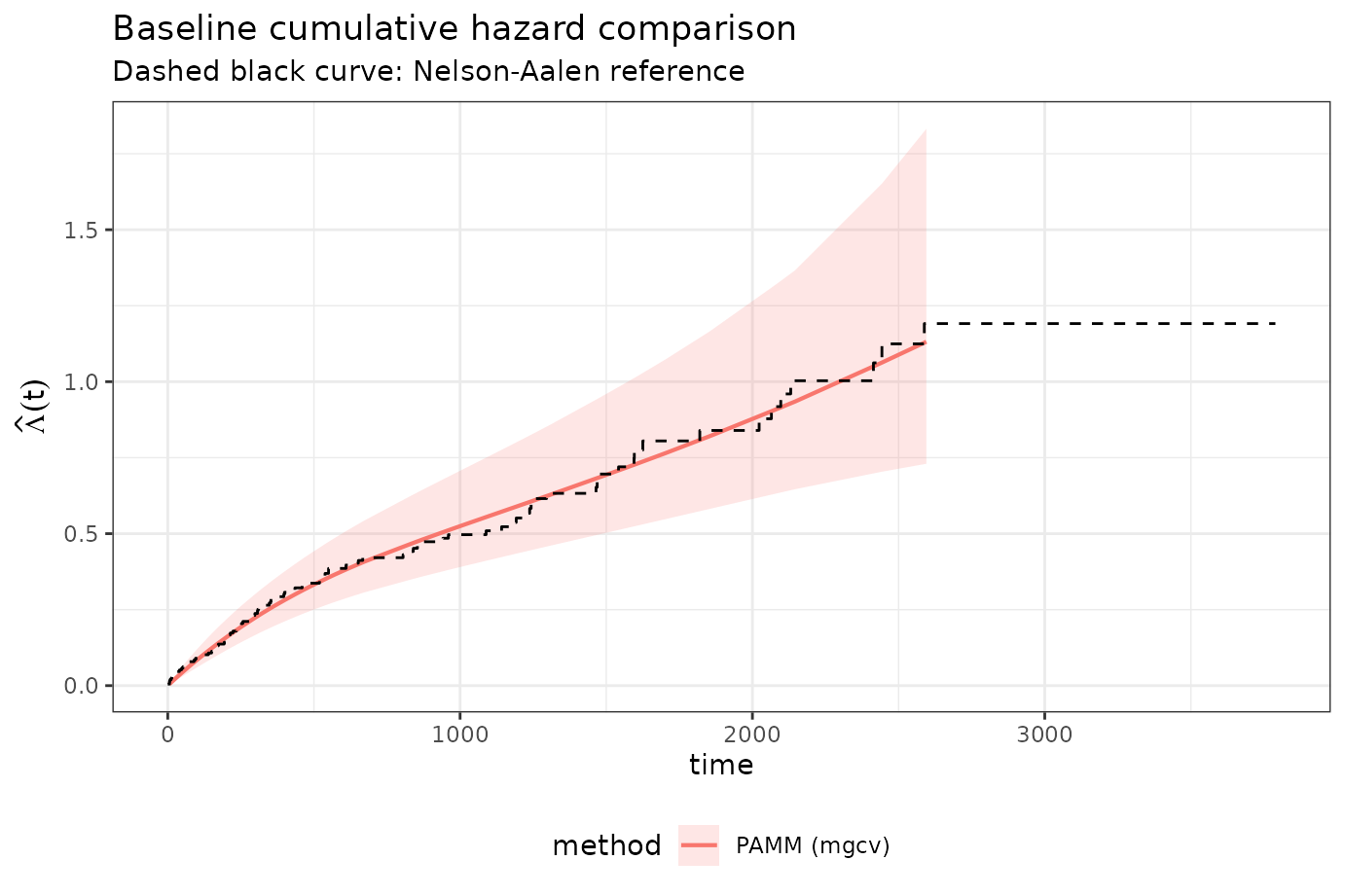
Numeric comparisons
Table code
| method | rmse_vs_nelson_aalen | max_abs_diff_vs_nelson_aalen |
|---|---|---|
| PAMM (mgcv) | 0.0209 | 0.0684 |
| Bayesian PAMM (jagam) | 0.0765 | 0.1572 |
| Bayesian PAMM (brms) | 0.0190 | 0.0637 |
Table code
cmp_pairwise_tbl <- bind_rows(lapply(pairwise_combos, function(ids) {
  lhs <- ids[[1]]
  rhs <- ids[[2]]
  diff <- pred_wide[[lhs]] - pred_wide[[rhs]]
  tibble(
    contrast = paste0(method_labels[[lhs]], " - ", method_labels[[rhs]]),
    rmse = sqrt(mean(diff^2)),
    max_abs_diff = max(abs(diff))
  )
}))
knitr::kable(cmp_pairwise_tbl, digits = 4)| contrast | rmse | max_abs_diff |
|---|---|---|
| PAMM (mgcv) - Bayesian PAMM (jagam) | 0.0738 | 0.1090 |
| PAMM (mgcv) - Bayesian PAMM (brms) | 0.0029 | 0.0062 |
| Bayesian PAMM (jagam) - Bayesian PAMM (brms) | 0.0737 | 0.1128 |